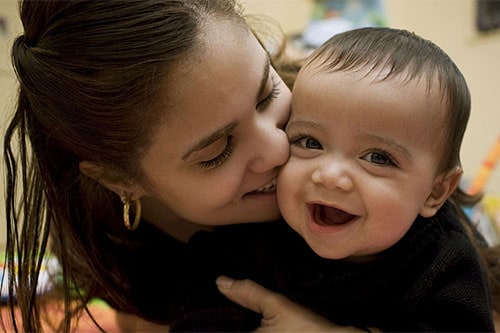
Neighborhoods are important
Another study this week proved the wisdom of HHH’s method of placing recently homeless families in great neighborhoods. A study from the Pew Trust (see News Tribune article below) demonstrated that the neighborhood one is raised in is a primary factor in determining whether or not someone will live in poverty as an adult or not – and whether they will regress further than their parents. Helping Hand House has made a point of placing our families in homes throughout Pierce County in healthy neighborhoods, without the stigma of being a low-income project, etc. Our criteria? If we wouldn’t move our own family in there, we won’t put those in our programs there either.
Research finds that neighborhood is key to income mobility
Location keeps some lower on ladderWASHINGTON – Researchers have found that being raised in poor neighborhoods plays a major role in explaining why African American children from middle-income families are far more likely than white children to slip down the income ladder as adults.
The Pew Charitable Trusts Economic Mobility Project caused a stir two years ago by reporting that nearly half of African American children born to middle-class parents in the 1950s and ’60s had fallen to a lower economic status as adults, a rate of downward mobility far higher than that for whites.
This week, Pew will release findings of a study that helps explain that economic fragility, pointing to the fact that middle-class blacks are far more likely than whites to live in high-poverty neighborhoods, which has a negative effect on even the better-off children raised there.
Even as African Americans have made gains in wealth and income, the report found, black children and white children are often raised in starkly different environments. Two out of three black children born from 1985 through 2000 were raised in neighborhoods with at least a 20 percent poverty rate, compared to just 6 percent of white children.
Using a study that has tracked more than 5,000 families since 1968, the Pew research found that no other factor, including parents’ education, employment or marital status, was as important as neighborhood poverty in explaining why black children were so much more likely than whites to lose income as adults.
See article here.
Summer reading keeps kids smarter…and a list of great summer books
The summer is here, and with it, the shedding of IQ points from American kids.
That’s right – kids actually lose a significant amount of a grade level over the summer – forcing the next year’s teacher to major in review before they can teach the new material. Helping Hand House has worked to combat this for several years in the children of our families, by providing a fantastic reading program of our own (and encouraging participation in the library’s version as a bonus! :) ). Children have the opportunity to win prizes and continue to grow mentally, while discovering and cultivating the joy of reading!
In honor of a summer full of reading, New York Times Op-Ed writer Nicholas Kristof assembled the following list of great books:
Op-Ed ColumnistThe Best Kids’ Books Ever
So how will your kids spend this summer? Building sand castles at the beach? Swimming at summer camp? Shedding I.Q. points?
In educating myself this spring about education, I was aghast to learn that American children drop in I.Q. each summer vacation — because they aren’t in school or exercising their brains.
This is less true of middle-class students whose parents drag them off to summer classes or make them read books. But poor kids fall two months behind in reading level each summer break, and that accounts for much of the difference in learning trajectory between rich and poor students.
A mountain of research points to a central lesson: Pry your kids away from the keyboard and the television this summer, and get them reading. Let me help by offering my list of the Best Children’s Books — Ever!
So here they are, in ascending order of difficulty, and I can vouch that these are also great to read aloud.
1. “Charlotte’s Web.” The story of the spider who saves her friend, the pig, is the kindest representation of an arthropod in literary history.
2. The Hardy Boys series. Yes, I hear the snickers. But I devoured them myself and have known so many kids for whom these were the books that got them excited about reading. The first in the series is weak, but “House on the Cliff” is a good opener. (As for Nancy Drew, I yawned over her, but she seems to turn girls into Supreme Court justices. Among her fans as kids were Sandra Day O’Connor, Ruth Bader Ginsburg and Sonia Sotomayor.)
3. “Wind in the Willows.” My mother read this 101-year-old English classic to me, and I’m still in love with the characters. Most memorable of all is Toad — rich, vain, childish and prone to wrecking cars.
4. The Freddy the Pig series. Published between 1927 and 1958, these 26 books are funny, beautifully written gems. They concern a talking pig, Freddy, who is lazy, messy and sometimes fearful, yet a loyal friend, a first-rate detective and an impressive poet. These were my very favorite books when I was in elementary school. A good one to start with is “Freddy the Detective” or “Freddy Plays Football.” (Avoid the first and weakest, “Freddy Goes to Florida.”)
5. The Alex Rider series. These are modern British spy thrillers in which things keep exploding in a very satisfying way. Alex amounts to a teenage James Bond for the 21st century.
6. The Chronicles of Narnia series. Look, the chance to read these books aloud is by itself a great reason to have kids.
7. “Gentle Ben.” The coming-of-age story of a sickly, introspective Alaskan boy who makes friends with an Alaskan brown bear, to the horror of his tough, domineering father.
8. “Anne of Green Gables.” At a time when young ladies were supposed to be demure and decorative, Anne emerged to become one of the strongest and most memorable girls in literature.
9. “The Dog Who Wouldn’t Be.” This is a hilarious, poignant and exceptionally well-written memoir of childhood on the Canadian prairies. (Note, if you prefer sweet to funny, try “Rascal” instead.)
10. “Little Lord Fauntleroy.” This classic spawned the Fauntleroy suit and named a duck (Donald Duck’s middle name is Fauntleroy). An American boy from a struggling family turns out to be heir to an irritable and fabulously wealthy old English lord, whom the boy proceeds to tame and civilize.
11. “On to Oregon.” This outdoor saga, written almost 90 years ago, is loosely based on the true story of the Sager family journeying by covered wagon in 1848, in the early days of the Oregon Trail. The parents die on route, and the seven children — the youngest just an infant — continue on their own. They are led by 13-year-old John: spoiled, surly, often mean, yet determined and even heroic in keeping his siblings alive.
12. “The Prince and the Pauper.” Most kids encounter Mark Twain through “Tom Sawyer,” but this work is at least as funny and offers unforgettable images of English history.
13. “Lad, a Dog” is simply the best book ever about a pet, a collie. This is to “Lassie” what Shakespeare is to CliffsNotes. The book was published 90 years ago, and readers are still visiting Lad’s real grave in New Jersey — plus, this is a book so full of SAT words it could put Stanley Kaplan out of business.
You can post your own suggestions for best children’s books on my blog, www.nytimes.com/ontheground. My own kids have the temerity to think they know better than I which books they’ve enjoyed, so I’ve deigned to post their recommendations there. But listening to one’s children is dangerous: I advocate reading to them instead.
Article in Puyallup Herald re: HHH’s 25 years of serving families…
A good article from the Puyallup Herald – thanks much!
Helping Hand House focuses on homelessness: Organization is celebrating 25 years in East Pierce County
Neil Pierson / Published: June 10th, 2009 08:00 AM
“We’re into permanent solutions,” she reiterated. “We want to provide services and programs that will help families never be homeless again.”
Many of Helping Hand’s “graduates” will be attending the organization’s 25th anniversary party on June 11, Renz said. She thinks that’s a great chance for clients to learn from others who’ve been successful.
Officials with Helping Hand House don’t think in the short term when it comes to solving the problem of homelessness.
Helping Hand, which was founded 25 years ago by Puyallup resident Margie Addington and still bases its efforts in the East Pierce County region, is very clear on its mission: Ending homelessness through a variety of education, awareness and fundraising efforts.
“An overnight shelter is not a good solution for really any homeless people because you can’t do anything,” said Nola Renz, Helping Hand’s executive director for the past 12 years. “All you’re doing the next day is looking for the next place you’re going to stay that night.
“We decided to try to approach this to have a long-term impact on the families and really help them to be stable and self-sufficient when they left us,” she added.When Addington started Helping Hand in 1984 it was a “really small grassroots organization,” Renz said. The organization still wasn’t very big when Renz took over in 1997, providing 11 homes and turning away about 25 families per month because they didn’t have the money to help them.That began to change over the last decade. Helping Hand now has 60 housing units scattered throughout Puyallup, Sumner, Bonney Lake, Buckley, Eatonville and Orting. In 2000 and 2001, the organization benefited from two federal grants from the Department of Housing and Urban Development, which contributed heavily toward the creation of two transitional housing programs and the purchase of 21 homes throughout East Pierce County.
Grant money, however, doesn’t come along very often, Renz said. Helping Hand relies heavily on volunteer support and donations to accomplish its tasks.
Lisa Heintz, Helping Hand’s volunteer coordinator, said a number of churches, community groups and individual partners donate time and money, assist clients with skills training and even find gifts and make birthday cakes for homeless children. Students from Emerald Ridge High School, Rogers High School, Aylen Junior High School and Pacific Lutheran University are just some of the youth who’ve been involved with Helping Hand, Heintz said.
Renz estimates that 75 to 80 percent of the people who seek assistance through Helping Hand eventually wind up with permanent housing. Over 25 years, the organization has served over 4,600 families.
Officials attribute the high success rate to several factors. Case managers help adults achieve financial literacy, proper education and interviewing skills to find employment. They also help children stay in school.
“Our case management is very intensive,” Renz said. “The case manager meets with the family at least once a week, talks to them often every day.”
Providing help for kids is just as crucial as it is for adults, Renz said, because it helps end the cycle of homelessness. Helping Hand’s statistics show that homeless children are four times as likely to have developmental delays and get sick twice as often. Nearly half of homeless school-age children suffer from depression or anxiety.
Helping Hand cites numerous success stories. Heintz spoke about a woman who escaped a “worst of the worse” domestic violence situation with her ex-husband. She had two children under 3 years old, was diagnosed as clinically depressed and had nowhere to live.
Within four months of setting goals, the woman passed her high school equivalency degree test “with flying colors” and the same day obtained a job in the health care field, Heintz said. Within a year of coming to Helping Hand, she had saved enough money to pay for her own residence.
“To be able to see that whole cycle work itself out, it’s pretty incredible,” Heintz said. “When you’re working so closely with these families, you really do get to know them.”
Helping Hand has two different housing plans for clients. Emergency housing provides those in need with a 90-day solution while they work on long-term stability plans with a case manager. Transitional housing allows families a place to live for up to two years while they receive extensive training in financial, education and job skills.
In addition to its emergency housing and transitional housing programs, Helping Hand assists residents who have received eviction or utility shut-off notices by paying their bills.
Honoring the amazing moms we see…
Moms, you’re pretty amazing…and this goes double for you courageous ones who have taken your kids in the middle of the night to escape abuse, who have worked 2 and 3 jobs, who have gone without food so your little ones can eat…who will make themselves nothing that their kids would have a shot at success. We love you and are thankful for you!
Happy Mother’s Day.
A terrible sight for families living in their car
This video, from the Wall Street Journal, shows a bank demolishing new homes in southern California. They determined it was cheaper to demolish them than try to sell them at this time. The heartache is what could have been done for the many families who have no home at all…
Click here to view the video.
TANF goes up – are families the winner?
Happy Cinco de Mayo folks…
The Associated Press reported today that there’s been a huge increase in people applying for TANF…article below:
OLYMPIA, Wash. —
The recession has more poor people applying for a Washington welfare program called Temporary Assistance for Needy Families.
The Seattle Times reports enrollments in the past year increased 18 percent to about 59,000 families.
The cost of the monthly grants to poor adults with children is expected to total $1.56 billion in the next two-year budget, a 9 percent increase.
A family of two – a parent and child – receives $453 a month. The amount increases by about $100 for each additional family member. Many families also receive food stamps worth about $100 a month.
Participants must take part in the WorkFirst job training or education programs.
As great as it is for folks in a crunch to recieve help, it’s that last line – that participants must take part in the WorkFirst program – that is the pinch in this situation. At Helping Hand House, our goal is to get families off of public assistance as quickly as possible, and into jobs that can support the household. We believe (and research backs us up on this) that the keys to sustainably ending family homelessness are education and living-wage jobs. WorkFirst shortchanges people by requiring moms and dads to get jobs that ultimately pay little and keep families dependent on the government. And while it makes sense to get people working while recieving public assistance, it is unfortunately one of the main hindrances our case managers face in helping our families get off welfare and into the mainstream working world…
Thoughts? We’d love to hear your comments…
“One child in 50 will be homeless…”
According to the Associated Press, as reported in the Tacoma News Tribune, “One U.S. child in 50 takes turn being homeless.” The article continues:
One of every 50 American children experiences homelessness, according to a new report that says most states have inadequate plans to address the worsening problem. The report being released today (3/10/09) by the National Center on Family Homelessness gives Conneticut the best ranking. Texas is at the bottom. Washington is in the middle at 25th. The report’s overall state rankings reflect performance in four areas: child homelessness per capita, child well-being, risk for child homelessness, and state policy and planning. The report analyzes data from 2005-6. It estimates that 1.5 million children experienced homelessness at least once that year.
And if that was ’05-’06, who knows what that number is now…? These are heartbreaking numbers – but believable – and ones we are working hard to reverse. Take a look around the next time you pick your child up at school…how many of those children waiting for a parent don’t have a safe home to sleep in tonight? A car is a hard place for a first grader to grow up…
No golden parachutes
Looking foward to sharing with you about the realities we see…this crisis is less about economic policy and bank defaults than families…families who are losing homes, whose kids need to switch schools in the middle of the year and have to make new friends…lost jobs and anxiety. The families with no golden parachutes. These are the realities we see every day, and the ones we want to share with you – the back end of the news that never makes the headlines. In the midst of this, we are making a real difference in the lives of families on the brink or in neck deep in homelessness – we want to share these stories with you, too. Thanks for reading…